I build training that actually changes how people work.
I diagnose capability gaps and design programs that stick, then prove it with data instead of just good reviews. I work across corporate and government L&D, from onboarding to leadership development.
Learning strategist with 14+ years diagnosing capability gaps and building programs that change how people work, not just how they complete training. I partner consultatively with business stakeholders: start with a needs assessment to diagnose the root problem, architect solutions leadership can act on, and validate results with data, from Kirkpatrick metrics to ramp time and cost savings.
I've built leadership development at every level, from new supervisors to directors and senior executives, and I've spent my career on the vendor side of corporate and federal L&D for clients like PNC Bank, FEMA, and the DEA. That means I know how training vendors operate. I'm comfortable owning a learning portfolio end to end, leading change across SMEs, analysts, and engineering teams, and using AI tools to move quickly from idea to deliverable.
The Engineering Lens
My other degree is a B.E. in Biomedical Engineering from Vanderbilt, and it shows up in how I work. I treat a training gap like a diagnosis. I get to the root of it, design a fix, pilot it on a small cohort, then validate with data before scaling.
Method
How I Build a Training System
Every engagement runs through the same five-stage cycle, whether the client is a federal contact center, a bank, or a nonprofit education program.
01
Diagnose
Sit down with stakeholders, SMEs, and frontline staff to figure out what's actually driving the gap before proposing a fix.
02
Design
Lay out the objectives, modality, and sequencing, and decide upfront how you'll know it worked.
03
Build
Build everything the program needs: slides, guides, scenarios, assessments, video.
04
Pilot
Test it with a small group first, see what works and what doesn't, and fix it before rolling out further.
05
Measure
Score it against Kirkpatrick levels, ramp time, and cost, then scale what the data supports.
Selected Work
Case Studies
Five projects across two organizations. One never got finished, but the rest show the same approach: diagnose the problem, build the fix, measure what changed.
01
Federal Agency · Steampunk
RSN New Hire Training Redesign
Problem
We inherited the onboarding training from the previous vendor with no clear organization or structure, and new hires were failing it. That was expensive to get wrong: each new hire needs a security clearance that takes months to process, then two weeks of training on top of that, so a failure meant starting the whole cycle over.
Approach
I ran a deep needs analysis to find where the training was actually breaking down, and realized the entire program needed to be rebuilt from scratch, and that it could run in 7 days instead of 10. I redesigned it around a Mission Impossible theme, with scenario-based learning that mirrored real calls, role-play, gamified badges and a leaderboard, and a full Jeopardy review game before the final exam. I also produced a promo video in PowerPoint to build excitement before each new cohort started.
−30%Ramp time (10 → 7 days)
100%Pass rate
100%Satisfaction
$23KEst. savings / yr
Artifact
Promo video shown to new CSRs to preview the training before it started. Made in PowerPoint.
02
Federal Agency · Steampunk
Supervisor Train-the-Trainer Workshop
Problem
Only one person could deliver the in-person RSN training, but we had three contact centers in different locations. My needs analysis showed the training didn't work well virtually, it had to be in person, which meant constant travel and a bottleneck: new CSRs sat waiting to be onboarded until that one trainer could get to their site.
Approach
I proposed a train-the-trainer program instead. The contact center manager identified supervisors at each location who could lead the training themselves, and I built and personally facilitated a 10-hour VILT (virtual instructor-led training) session teaching them how to become trainers and facilitators, not just presenters. That gave every location its own facilitator, which closed the onboarding bottleneck and cut the travel costs.
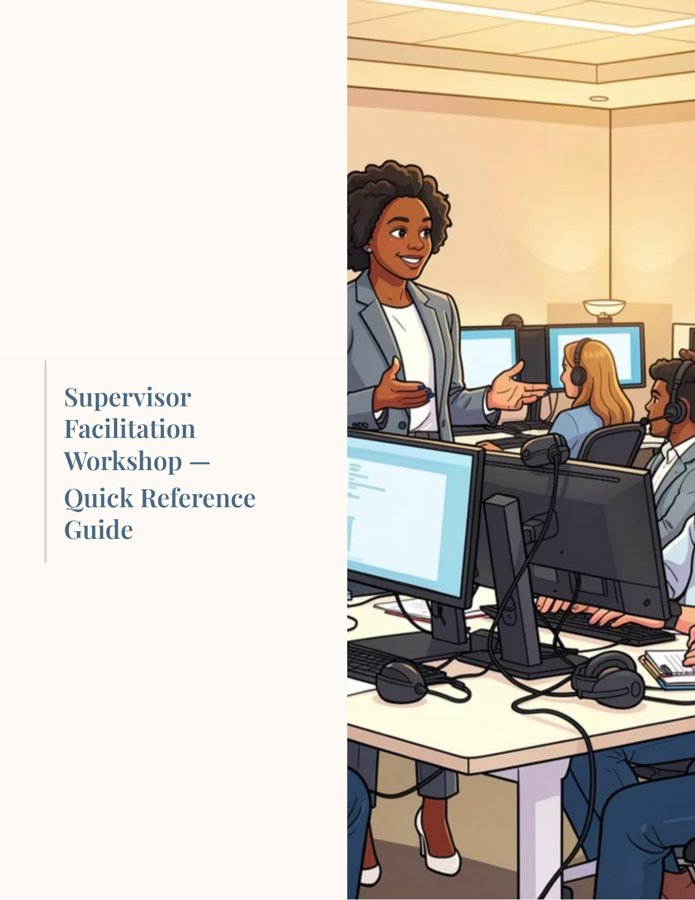
Created as a refresher for participants after the workshop. Built in Gamma and PowerPoint.
03
Federal Agency · Steampunk
Knowledge Base Modernization
Problem
CSRs relied on a 140-plus page static document, nicknamed the “RSN Bible,” to look up facts and answer customer questions on live calls. Search was slow, so finding the right answer quickly was a struggle, and the information went stale fast. Every update meant reworking the entire PDF, which was a huge lift.
Approach
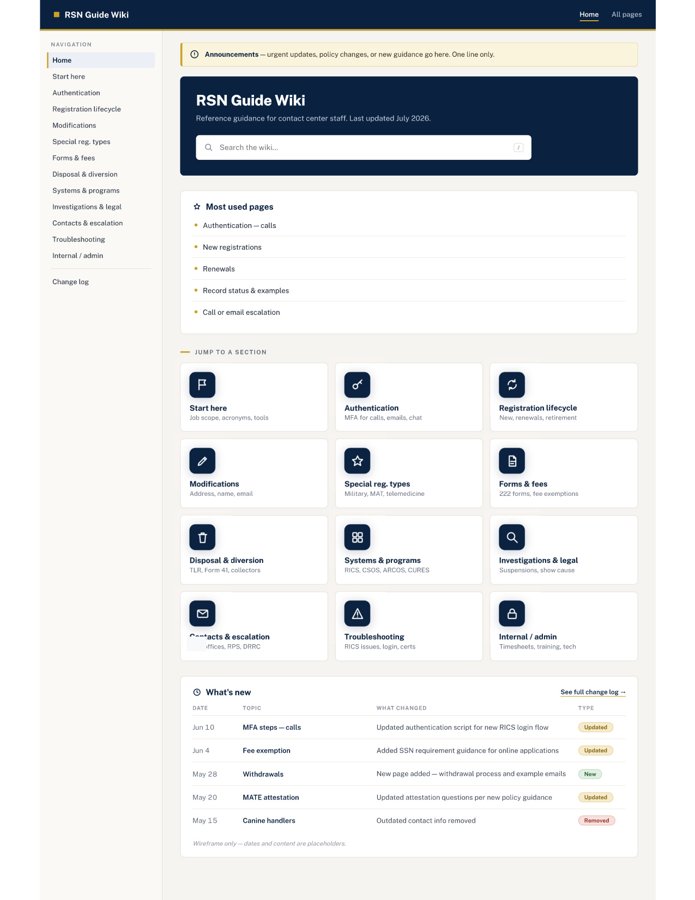
I ran discovery interviews with CSRs and their supervisors to see where the guide broke down in real use, then broke the RSN Bible into chunks: a SharePoint wiki for the full reference, plus shorter articles linked directly into Salesforce as Knowledge Articles CSRs could pull up mid-call. It also made updates far lighter: instead of reissuing the whole guide, we could just update the one section that changed.
Nonprofit Education Organization · Assistant Director of Education
Program Heads Leadership Training
Problem
Program heads at this organization were almost always promoted into leadership straight from teaching, stepping into roles like principal without ever being trained on how to lead. They had to figure out managing staff, developing teachers, and engaging students entirely on the job.
Approach
I designed and facilitated a 6-hour VILT (virtual instructor-led training) session broken into three modules: managing staff, developing teachers, and inspiring students, each built around scenario-based activities and case studies drawn from situations they'd actually face. Post-training surveys were strongly positive, with participants saying they wouldn't change a thing and were surprised by how much they'd learned in such a short session.
+30%Enrollment
+25%Learner outcomes
−40%Classroom disruptions
05
Federal Agency · Steampunk
CSOS Training Video
Problem
The contact center had no formal training for CSOS, which provides subscribers a digital certificate they use to place orders through their own vendors. Before this, a DEA subject matter expert would come in periodically to give refreshers to the reps who already handled CSOS calls. Management wanted every rep dual-skilled in both RSN and CSOS, so we needed a real training path instead of ad hoc refreshers.
Approach
Off the success of the RSN redesign, I was tasked with building a brand new two-week, in-person ILT training program for CSOS from scratch, so RSN reps could get dual-skilled. To build excitement before it started, I also wrote, shot, and edited a teaser trailer in PowerPoint to screen ahead of day one.
Artifact
Made in PowerPoint.
In Their Words
From Managers, Clients & Peers
“
I recommend Wida without hesitation or reservation. Any organization would be fortunate to have her on its staff.
Melinda Quinones, Contact Center Supervisor at Steampunk
“
What she is doing typically takes a staff of two to three people at least six months.
Kiah Guilford, Senior Service Designer & Manager at Steampunk
“
She created something engaging, interactive, and effective, so our customer service representatives are prepared to handle registrant calls accurately and confidently. Huge shoutout for raising the bar.
Giovanna Ubillus, VP at Steampunk
“
Wida consistently demonstrates Quality at Speed. She stays laser focused on her goals, and she's always quick to help teammates out.
Alicia Serrato, Steampunk Colleague
“
I highly recommend Wida for senior positions in curriculum and learning design due to her creativity, her leadership in innovating with new technologies, and her ability to build rapport with clients.
Claudia Escribano, Director of Creative Learning Solutions at C2 Technologies
“
Within weeks, she was managing her own courseware development with on-time, low-error deliveries.
Janeann Hudson, Manager at Carley Corporation
“
Her enthusiasm for learning new technologies and methodologies is infectious. If you have a position where she can explore and challenge herself, she'd be a great addition to your team.
Wendy Darnell, PMP, PgMP, Program Manager at C2 Technologies
“
Wida has been such a breath of fresh air since joining our team. She brings new ideas and recommendations with thoughtfulness and clarity, always delivering them with such graciousness.
Maggie Jolitz, Colleague at Steampunk
“
Your work on the RSN training was outstanding, 100% satisfaction scores and feedback calling it the best training yet. That kind of impact doesn't go unnoticed.